Sunday, 11 November 2012

The Christmas Season – Dresdner Christstollen


This is a famous recipe, and tricky to make, on account of the large amounts of butter, raisins, almonds, etc – yeast prefers to work with plain flour cakes.  Nevertheless it is a must for many German homes at Christmas time.  Lesser individuals buy it in shops, but yours truly prepares her own most years.  Partly because mine is better than the shop bought variety, partly because it makes a very good Christmas present!

There are any number of recipes, I am using an old one from before the war (the Boer War, if you must know!), suitably adapted for my situation and with a few personal improvements thrown in.  I have taken lots of photos, so you can see exactly what I am talking about.

My cookbook doesn’t give a proper list of ingredients at the beginning, but I give a list here for your convenience.

2 kg Flour
200 gr Beer-yeast (I have never been able to track this down, so use regular fresh or freeze dried yeast, a bit more than I would use for making regular cakes or bread)
1 l Milk
400 gr Sugar
Zest/Peel of two Lemons (organic, ideally)
1 Teaspoon Cardamon
¼ Teaspoon Macis
¼ Teaspoon Salt
400 gr Almonds & some bitter almond extract
500 gr Candied Citrus Peel
1 kg Raisins
300 gr Currants
900 gr Butter (plus some for basting later)
Liqueur?

Take the butter out of the fridge!

Get hold of the largest bowl in the house – it will need to accommodate an awful lot of ingredients!  Put in the flour, put bowl with flour in a warm place.


Mix yeast with sugar and warm milk.  Once the sugar is dissolved and the yeast starts to bubble, make a dale in the flour in your bowl and pour the milk/sugar/yeast mixture into it.  Mix some of the flour into the milk, just enough to make a thin slush – at this stage you don’t want a proper dough, just a sloshy pre-dough.  Put bowl in a warm place and cover with a clean kitchen towel.  Let the yeast grow and expand – this will probably take an hour, but it depends on your yeast, the temperature of your kitchen, how warm the milk was, etc etc.  Play it by ear.

While the yeast is multiplying, you prepare the other ingredients.  Wet the raisins and currants with the liqueur of your choice, maybe half a cup (optional).  If you use too much liquid you may need to add more flour later on.
 

The recipe calls for the almonds to be stripped naked, I never do this, being a prude.  The skins are healthy roughage, and I am leaving them on.  I grind them together with the candied citrus peel, because if you have proper citrus peel it will be sticky and grinding it with the almonds makes the job less messy.  In the past I always used a mechanical grinder, and these work very well.  Unfortunately I have some arthritis in my hands, and am trying to cut down on repetitive jobs that strain my wrists, so this year I bought a little electric grinder – a mini food processor, as they are called.  It worked very well, the consistency of the almonds and candied peel is exactly the same as what the hand grinder produced.  Since the electric grinder is quite small I had to grind several batches, but that is the same with the hand grinder so no problem. 

 Left bowl ground almonds and candied peel, right bowl unground almonds and peel
 
You may be tempted to just buy already ground almonds, or even add mincemeat to your dough.  I advise against this.  The consistency of your dough would be different, which could result in the cake over or under baking.  Also the cake would be less moist – almonds which have been ground months ago are bound to be less fresh than those you grind minutes before you bake the cake.  If you think this recipe is too much work and you want to save yourself some trouble, I would advise to use a different recipe.  If you ‘simplify’ this one you will end up with a cake which is no better than a shop bought one, in my opinion.
The butter needs to be soft, but not melted.  Since you took it out of the fridge several hours ago, it will be almost right by now.  Cut it into many small pieces into a bowl and stir it vigorously with a spoon.  If you can’t stir it the butter needs to warm up a bit more.


Wash and scrub your lemons and scrape the zest off with a grater.  Only use the zest (yellow bit), none of the white bit should be grated.
Now all your ingredients are ready, and it is time to check on the pre-dough in the large bowl.  If it has expanded and is bubbling nicely, you can proceed to add the spices and salt and lemon zest and knead it really really well.
 
 
The word ‘knead’ is probably derived from ‘kneel’, because that is the best way to knead a dough like this one properly.  Put the bowl on the floor, kneel in front of it, and knead it until you have a nice round ball, neither sticking to your hands nor bone dry.  It should have the consistency of bread dough.  The kneading should take about half an hour – put on the radio so you don’t get bored and give up before the dough is properly done.


Now cover the dough in your bowl again with the towel and let it rise again for a while, until you are satisfied that it has risen enough to carry the weight of all those other ingredients.  Keep in mind that the parts of the dough that contain the yeast and will cause the cake to rise properly will be mixed with lots of butter and raisins and almonds and peel, none of which will make the cake rise.  So if you don’t let the starter dough rise long enough to gather its strength, as it were, it will have no chance to rise once all the other ingredients have been added.  Think of the other ingredients as burdens which have to be carried – lifted up – by the yeast dough.  If the yeast dough has not fermented properly it could perhaps give a good risen cake by itself, but with all the other ingredients added it will simply be overwhelmed and you will get a flat cake.  That is the reason why this is a difficult cake to make – there are so many ingredients that can’t contribute to the rising of the cake that it may remain flat.
 
Pre-heat oven to 200C (gas mark 6).
 
OK, now you have a good yeast dough, well leavened throughout and ready to carry all those other ingredients through the baking process.  If you have a seriously large bowl (like a washing up bowl), you can simply add all the ingredients not yet used into the bowl.  If you only have a bowl which is too small for holding all the ingredients at once, you may want to divide the dough into several pieces and knead it in batches.  Being the proud owner of a huge monster bowl I can do the mixing and kneading in one go.  I just throw all the remaining ingredients into my bowl, on top of my yeast dough.  Then I check my ingredients list, making sure I have not left anything off.  Then I place the bowl on the floor again, kneel down in front of it in a respectful manner, and knead and knead and knead.  It will take another half hour or so.  When you are satisfied with the result, cover again with the towel and put into a warm place for another half hour or so.  Once it has risen sufficiently, knead through one last time and divide into pieces for baking, either on a cookie sheet or in tins.


Stollen type cake has a typical shape, which is achieved as follows.  Form a 5 to 10 cm thick rectangle from your dough and lay it onto a cookie-sheet so that 1/3rd is laid on top of the remaining 2/3rds.  It will look like this:  __---     Sort of like a slope, a rolling hill.  Anyway, whenever I try to do this the dough disobeys and I never get the typical stolen-shape but just a formless slab.  So I have given up and am using normal baking tins instead.  Since I give most of my stollen away this works quite well – I can give away individual little cakes rather than slabs of a cut up large cake. 
The amount of dough this recipe yields was enough to fill the following tins:
2 small round cake tins
2 medium round cake tins
2 medium rectangular cake tins
2 large rectangular cake tins.


I baked them in three batches.  Use second grate from the bottom.  It is inadvisable to put cake tins on more than one grate, somehow they never bake evenly.  Even having more than one cake tin on the same grate affects how they bake.  My first batch included one large and two small tins.  After one hour one of the small tins was done, but the other needed another 15 minutes.  The bigger tin took an extra 15 minutes as well.  Put some aluminium foil over the tins for the first 30 minutes or so of baking, to stop them from going brown at the top too quickly.  The baking time is supposed to be 1 hour, but for me it is always at least 15 minutes longer.  Keep checking by sticking a wooden toothpick into the cake – if it comes out with no dough clinging to it the cake is done.

While the first batch of tins bakes the next two batches sit around waiting and rising a little more.  I see no harm in this.


When your cakes are done, let them cool a little, then take them out of their tins and on to a rack.  Anoint them with melted butter and add icing sugar on top.  If you make the cookie sheet/rolling hill shape of stollen you can cover the whole thing in melted butter and sugar, but if you use tins you can only do the top, so your cakes will look less attractive (if you think a cake that looks like a ski-slope is attractive, that is).  So you could try to cover your cake with a glaze or even a marzipan covering.  Not authentic, but can be quite nice.

After the cakes have cooled down, wrap in heavy duty aluminium foil and store in a cool dark dry place for at least a week before eating.  I have kept some in the vegetable compartment of the fridge until Easter – this cake is a keeper, unless it gets eaten too soon, of course.


Secrets of success?  Use top grade ingredients, and be patient when it comes to kneading and letting it rise.  The ingredients for this cake don’t come cheap, so you want to do everything you can to make sure it is a success.


The whole process took me about seven hours, by the way, so make this cake on the weekend when you can stay in all day.


Saturday, 10 November 2012

Having the Chimney Swept


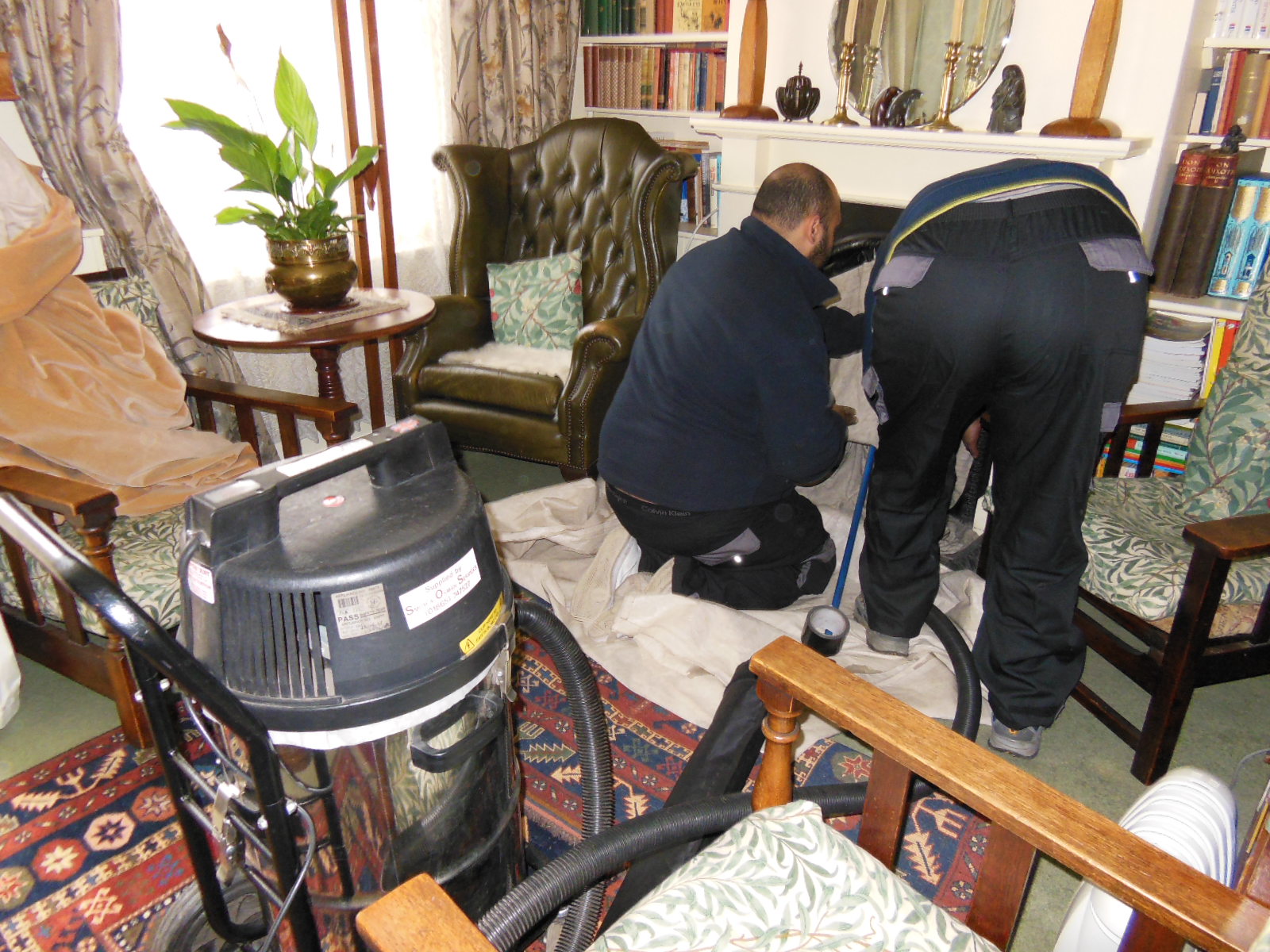
I have not had my chimney swept for a few years, and it was getting high time, so I was very pleased when I found a company who was happy to send two sturdy sweeps out on a Saturday, for the reasonable sum of £35.  They were exactly on time and left no mess at all!


Nowadays chimney sweeps don’t climb onto the roof to lower a long-handled brush down the chimney (not do they send small children down the flue, which is just as well, since the size of mine would require a two year old toddler).  Instead of this top down approach they now use a bottom up method.


The two gentlemen taped a cloth over my open fire grate, and inserted a brush as well as a vacuum cleaner hose up the chimney.  The brush cleaned the chimney flue and the vacuum cleaner hovered up all the soot and dirt the brush dislodged.  When they were finished they vacuumed the area all around the fireplace and left it cleaner than they found it.


I observed them with eagle eyes, obviously, ready to pounce at the slightest infraction, but they were very good.  I also went outside, to watch the brush coming out on top of my chimney – doesn’t it look cool?

After that the chimney sweeps let off a smoke bomb in my grate, to test whether the flue was fully functioning.  I went outside again and watched the smoke escape from the top of my chimney – tried to photograph this, but the weather was too overcast for the smoke to show much.


Anyway, my chimney got a clean bill of health, and the upcoming cold season holds no more fears for me.  I have a stack of kindling and a large rubbish bin full of smokeless coal, apples in the fridge and chestnuts in my cupboard – long grim Winter here I come!

Wednesday, 7 November 2012

The Christmas Season – (Wrapping) Christmas Presents


Perhaps you think this is a wee tad early?  Well, let me tell you, I start wrapping Christmas presents as soon as I buy them, ideally in January.  If you wrap a present as soon as you buy it, there is every chance that you will have forgotten what is inside the package by the time Christmas comes around.  That’s what I do, anyway, with my own presents.

I have a basket of everything necessary for wrapping gifts on top of my wardrobe.  All sorts of papers, ribbons, little decorations, scotch tape, scissors, eraser (for erasing the prices pencilled on the fly leaf of second hand books), etc.  Piled next to it are presents that need wrapping.  Every so often I take down the basket and unwrapped presents and have a little wrapping party on the floor of the Nostalgia Studio.

Tonight was one of those occasions.  I need to get ready several packages for overseas recipients, and there were a few last minute entries for myself as well.  Recently wrapping paper has become rather thin, which is irritating for people like me who like to recycle their wrapping paper.  My advice is, buy the best quality – ie thick! – paper you can lay your hands on for presents to yourself or people from whom you can snatch the paper back after they have unwrapped their gifts.  For people who you suspect just throw their used wrapping paper away use the usual, thin, easily torn, variety of paper.


The same principle holds for ribbons and other decorations, of course.  I have some ribbon I have used half a dozen times, and it still looks lovely.  Well worth paying the extra money for.

Some gifts are tricky to wrap because they are rather bulky and/or awkward.  For these I use simple brown paper, which is both cheap and sturdy.  When decorated with an abundance of fancy ribbon is looks quite nice, really.  Usually I favour red and green and golden paper, because I consider it most Christmassy. 

I am uniquely lucky in being the proud owner of a four poster bed.  That means I have a bed with a roof, and on top of that roof I store my wrapped presents.  That way they are out of the way, but whenever I feel the urge I can climb onto my stepladder and have a peek and gloat in anticipation.


This year most people get perishables from me, as part of my de-cluttering drive.  It doesn’t seem right to de-clutter my house while re-rubbishing everyone else’s homes.  So people will get home made alcohol, candles, cookies, cakes, pralines, and anything else my fertile imagination can concoct.  Obviously I can’t wrap that yet, this being the beginning of the production cycle.  But I have already made a good start.

Yesterday I mixed the dough for Pfefferkuchen, the one that needs to sit in a warm place for three weeks, then gets baked, then needs another two weeks sitting in a tin to get soft.  I am not covering this recipe in my blog, because it is tricky and often even I don’t get it right, after 30 years of making it.  It involves potash and continuous heat, which was easy in the olden days when people had ranges that were stoked 24/7, but in this day and age it is a bit of a struggle.  Nevertheless, I have high hope for this dough, and if it works out it will make its way into several presentation boxes for my favourite friends.

This Saturday I will start the Dresdner Christstollen, the one I made the candied citrus peel for.  Again not an easy recipe, given the significant amounts of butter involved, but I shall endeavour to photograph the proceedings and give the recipe as well, in case anyone feels inspired.  I bought a huge bowl for it today, the one I used in the past had to be given over to the birds after their bath cracked last winter – the recipe results in rather a lot of dough, I am afraid.

Another Christmas surprise – both for me and the potential recipients – is my Elderberryport.  It is my favourite tipple, dreadfully expensive and hard to come by.  So ten years ago I decided to make the stuff myself.  I gathered the berries and followed the recipe to a t, and when I had laid down three gallons read the recipe again and discovered that it needs to sit for ten years before it can be drunk.  Since then I made another gallon for several years, until I ran out of space.  Also I reflected that if the recipe was a dud I would be stuck with about 8 gallons of potentially lethal wine, and decided to cease making any more until I had tasted the results.  Since then the 8 demijohns have been sitting in the Mouserleum gathering dust and all but forgotten.  However, when I recently de-cluttered the Mouserleum I had a look at the tags on the demijohns and discovered to my surprised that the ten years were up and the wine is ready to be decanted and tasted!  As soon as I can lay my hands on a few empty bottles I will assemble a group of stout-hearted friends and open the first sealed demijohn!  If the stuff is any good, a few bottles will be passed on to trusted friends.  If not I will - well, I don’t know what I will do.  After waiting for ten years it had better be good!  I shall report in due course.


Friday, 2 November 2012

The Christmas Season – Making Candied Citrus Peel


There are two kinds of candied fruit.  The fancy kind that takes a long time and is eaten as a sweetmeat, and the basic kind that is quite fast to make and is used for baking and cooking.  This post is about making the basic kind.

It is very important that one obtains fruit that have not been subjected to herbicides, pesticides, or waxing, since the peel itself will be eaten.  Organic is ideal.  I ran all over Oxford looking for them, and after three days finally found them at Waitrose in Headington.  The more different types of citrus fruit one can get the better, grapefruit for example are really nice.  I only found oranges and lemons, which I will have to make do with until I find a greater variety of fruit.

I bought six lemons and six oranges.
 
First, wash the fruit in hot water and scrub a bit with a brush.  If you have not been able to buy untreated fruit, scrub especially hard!  Now dry fruit on a clean towel, cut in half and remove the juice.  You can drink it or use it to cook the fruit in (later! not at first!)  Then cut each half one or two more times.  You need to remove the inside of the fruit, until only the peel (including the white bit) remains, and this is easier when the pieces are not too large.


After having removed the inside, cut the peel into pieces.  I usually cut pieces of about an inch long and a quarter inch wide (3cm by ½ cm), but suit yourself.  Weigh the cut peel (I had a bit over 500gr).  You need the same weight in sugar (castor sugar is best, I ran out and added some brown sugar).


Put peel into pot, cover with water.  Bring to a boil.  Throw water away.  Cover peel with fresh water, bring to a boil, boil for 15 minutes, discard water.  Now you can use the juice, if you want to!  Heat it up with some water, and slowly add the sugar until it is all dissolved.  Bring to a boil.  Add the peel, bring to a boil.  Turn off heat, leave peel to soak in the sugary liquid overnight.  The next evening, bring to a boil and simmer on a low flame for two or three hours until the liquid is pretty much gone.


That’s the basic recipe.  If you want to add a special touch, pour some orange liqueur over the candied peels when they have cooled a little, stir well and leave overnight to cool down.  The next day fill into glasses.  This peel will be quite moist, a bit like orange marmalade, depending how long you boil it. 


I mainly use this peel for my Christmas baking, like Dresdner Christstollen.  I crank it through my old hand-grinder, usually well mixed with almonds, so that the grinder has a better grip – also it makes the proceedings a bit less sticky.  However, it is also very nice in sauces and – if you still make such things – steamed puddings.

Happy candying!


Monday, 29 October 2012

Time to Start the Christmas Season!


OK, so I am a little behind …I have been so busy de-cluttering that I almost forgot about my Christmas preparations.  Sad but true.  But I have made a lot of progress, so will be able to take out some time for wrapping present and baking cookies and stuff.

I have decided to respect other people’s space as well as my own by not giving them any Christmas presents.  Handy and cheap for me, you might think, and consider me a cheapskate and a tightwad.  Since I am the number 1 fan of Uncle Scrooge this does not faze me.  Anyway, you are quite wrong; although I shall no longer give the sort of rubbish which clutters up other people’s houses, I shall continue to give them (a) perishables, ie things to eat and drink and use up, (b) useful things, ie something they really do need, and (c) small things which take up little space yet are very beautiful, ie scarves and Christmas Tree ornaments.

(a) Shall be the subject of quite a few of my posts between now and Christmas, because I plan to give cookies and Stollen and perhaps even Dominosteine to my favourite friends.  I will make photos, too, so those among you who live to far away to receive baked goods can at least look at the finished products and imagine they are eating them.  I am very kind and generous that way.

(b) Is a minor category as far as my friends are concerned, since they are all rich and need nothing.  I have managed to find a little something for K, who is not really poor but has this habit of admiring something and then not buying it, and then regretting not buying it.  A very useful habit for me, because I quickly rushed out and bought it for her!

(c) Was much on my mind yesterday, because I haunted the website of my favourite Christmas Tree ornament manufacturer and ordered a few special items – some for myself and some for a few select friends.  These ornaments are very small and flat, so one can shove them into an envelope together with a Christmas card as a little present.  They are made of pewter, and beautifully painted, and I like to buy a few every year for my Christmas decorations trove.

So buying Christmas presents is not really necessary, except for a few little ones for myself.  Lest you think I have all of a sudden become frugal, let me assure you that I have bought all the big ones for myself a long time ago and am hoarding them in a secret location!

The most urgent thing now is to prepare the dough for Pfefferkuchen.  You may have encountered them in large cellophane bags in the cheaper shops in the pre-Christmas season, and wonder why I propose to produce such sad specimens of the cookie world.  Well, obviously mine are better!  I use an ancient tested recipe, and have been ordering ingredients from the German Bakery in London recently.  Sadly they didn’t have Butter-Lard, so I have to make it myself again.  Luckily I have an old cookbook that explains how.  If you live in a foreign country, far away from the flesh-pots of Germany, you learn to make everything yourself.  Would you believe I even made my own Quark, a sort of cottage cheese, so I could make cheesecake, when I lived in Oregon?  The list of my talents is extensive.

Anyway.  These Pfefferkuchen have two time-consuming requirements.  Firstly, the dough has to sit in a warm place for two or three weeks prior to baking.  Not an easy thing to achieve in my non-centrally heated house!  Secondly, they need at least two weeks to lose their rock-hard consistency after baking.  You do the maths!  It is high time I got going.  It’s this week or not at all!  Time's awasting!

After that the Dresdner Christstollen must be tackled.  Then Nuernberger Plaetzchen.  After that I will make Zimtsterne (except I never use the star-shaped form, way too much work), and probably Buttergebaeck.  Plus Nuernberger Lebkuchen, can’t miss them off the list.  And when all that is done I am going to try something new:  Dominosteine.  Never made them before, but I have high hopes.  They are dreadfully expensive to buy, so making my own will be a huge savings.  Except that I will eat about ten times as many and not save a penny – let’s not go there.

The other thing I am considering is making some more candied citrus fruit peel.  It is much better than the stuff one can buy ready made in shops, and doesn’t really take all that long to make.  I am almost out of the batch I made a few years ago.  Wonderful in the stollen!  The problem is, I need fruit that have not been treated with herbicides, pesticides, wax, and any of the other chemicals that poison the regular varieties.  This Saturday I am in London, perhaps I shall nip over to Harrods …

Of course there are many other things to do aside from baking.  I must dip a few bees wax candles, supplies are running low and maybe I will make a few spare ones and give them away as presents.  Things will really heat up just before the first of Advent, because ideally everything should be ready then.  But there is still plenty of time, and if one is organised one can get everything done.

So onwards and upwards, allez hop, los los zack zack mach schnell!

The pre-Christmas season is now officially open!


Tuesday, 23 October 2012

Shopping for Plants in Paris


Paris is great for buying potted plants.  There are any number of street markets where one can purchase plants – and especially flowers! galore, but my favourite is just down the road from Notre Dame.  It is called Allee Celestin Hennion, and consists of a number of large green houses, filled to the brim with plants in pots.  There are also  plant shops on the other side of the Seine, and indeed pet shops as well, but although they sport alluring items like ten foot long artificial alligators, I prefer the ones at Celestin Hennion.  Photos are better than words to describe their manifold attractions, so here they are!


It rained and drizzled and dripped throughout my stay, but I dare say the plants loved it.  I was OK with it, too, since I was in excellent company and had some severely entertaining chats, and good food and drink, too.  The only fly in my ointment was that I did not find any new Oncle Picsou magazines.  Oh well, better luck in November!


Monday, 15 October 2012

The Great Post-La Bourboulian De-clutter Craze


It’s been a while since I last posted.  Partly this is because I have been frightfully busy at work, but mainly because I have been frightfully busy at home.

Whenever I return from La Bourboule I embark on a massive de-cluttering orgy.  One year it was the attic, then the cupboards, after that the kitchen.  When I am in La Bourboule I have a large spacious practically empty apartment.  There is practically no clutter.  Just a bed, a table, a few chairs, a cupboard for dishes, a wardrobe for clothes – and that’s it.  No books, no knickknacks, no pictures, no carpets – no dusting!  It is so restful for the mind, and so calming to the nerves.  And so great not to have to dust!  I am at heart a minimalist.  Unfortunately I am also at heart a Victorian pack rat.  An uneasy combination!  Anyway, whenever I return from La Bourboule the minimalist is in the ascendancy, and my mind craves simplicity.  So I de-clutter with a vengeance until the feeling wears off.  But this year I took things much further – my health was at stake!

For a year or two I had noticed an occasional tendency for the inside of my nose to swell, with the result that breathing through it was difficult, especially at night when I was in a horizontal position.  This was not an asthma issue – breathing through the mouth was fine.  OK, so I have a narrow nose, but this was a new problem for me.  I bought a little anti-snoring device that kept my nostrils open at night which I used when necessary and thought no more about it.  But within 24 hours of arriving in La Bourboule the problem disappeared.  And within 24 hours of leaving La Bourboule it re-appeared.

Putting on my detective hat I analysed the situation.  Why did I not have this problem in the past?  What had changed?  And why was this not an issue in La Bourboule?  We had just had two very cold winters.  I had secondary double-glazed all the windows.  I.e. I had not been keeping the windows open a lot these last two winters.  Which reduced ventilation.  Which lead to a build-up of indoor pollution, dust particles, etc.  Which resulted in some sort of allergic reaction in my nose.  That was my theory.

Extensive googling confirmed my hypothesis that asthma and allergies increased in houses with double glazing and insulation.  Doggone it, I had been so proud of my insulated house, and now I have to face the fact that I had basically sealed myself into an allergy producing chemical dustbowl cum hellhole!  Dash dash dash!!!!

What’s a woman to do?  The obvious thing would be to sell up and move to La Bourboule, but the market for university fundraisers is decidedly limited there, so I would be very poor, if disgustingly healthy.  Alternatively I could try and clean up the house.  That’s what I have been doing ever since I came back from La Bourboule.

Firstly, I surveyed my possessions.  They were manifold and gathered dust easily.  To clean the house was very laborious, partly because of my dust-catching possessions, partly because I have so much stuff that vacuuming requires an awful lot of moving of furniture.  As a result I dusted & hovered less often than was desirable (from an allergy point of view).  Therefore I decided to first thin out my possessions.

I donated 36 large shopping bags full of books to the Oxfam bookshop; I even filled out a gift aid declaration, I expect they will make a small fortune.  Then I summoned my trusted antiques dealer and sold him the following:  four bookcases, two large arm chairs, two tables, a mirror, a stepladder, a magazine rack, a laundry rack, and a few other bits and pieces.  This required quite a lot of work – going through one’s books and deciding which ones to throw out requires both time and moral fibre, as does finding places for all the knickknacks that had rested on the tables and bookcases I had sold.  I got rid of most of them.

The biggest struggle was a certain armchair, which I loved fiercely despite being totally useless and consistently in the way.  In the end I bribed myself.  I am technically on a scarf-ban (I have so many that I decided to stop buying them for a while), but for this noble purpose allowed myself an exception.  So I swapped the chair for Rythmes du Monde.  Half of me feels pathetic for needing to be bribed to let go of the chair, half of me is grateful there is something I can be bribed with – without my lust for scarves I would still be stuck with that chair!  It was touch and go – five minutes before the dealer arrived I almost decided to keep it, but told myself sternly that I had bought the scarf so could not back out of the deal now.


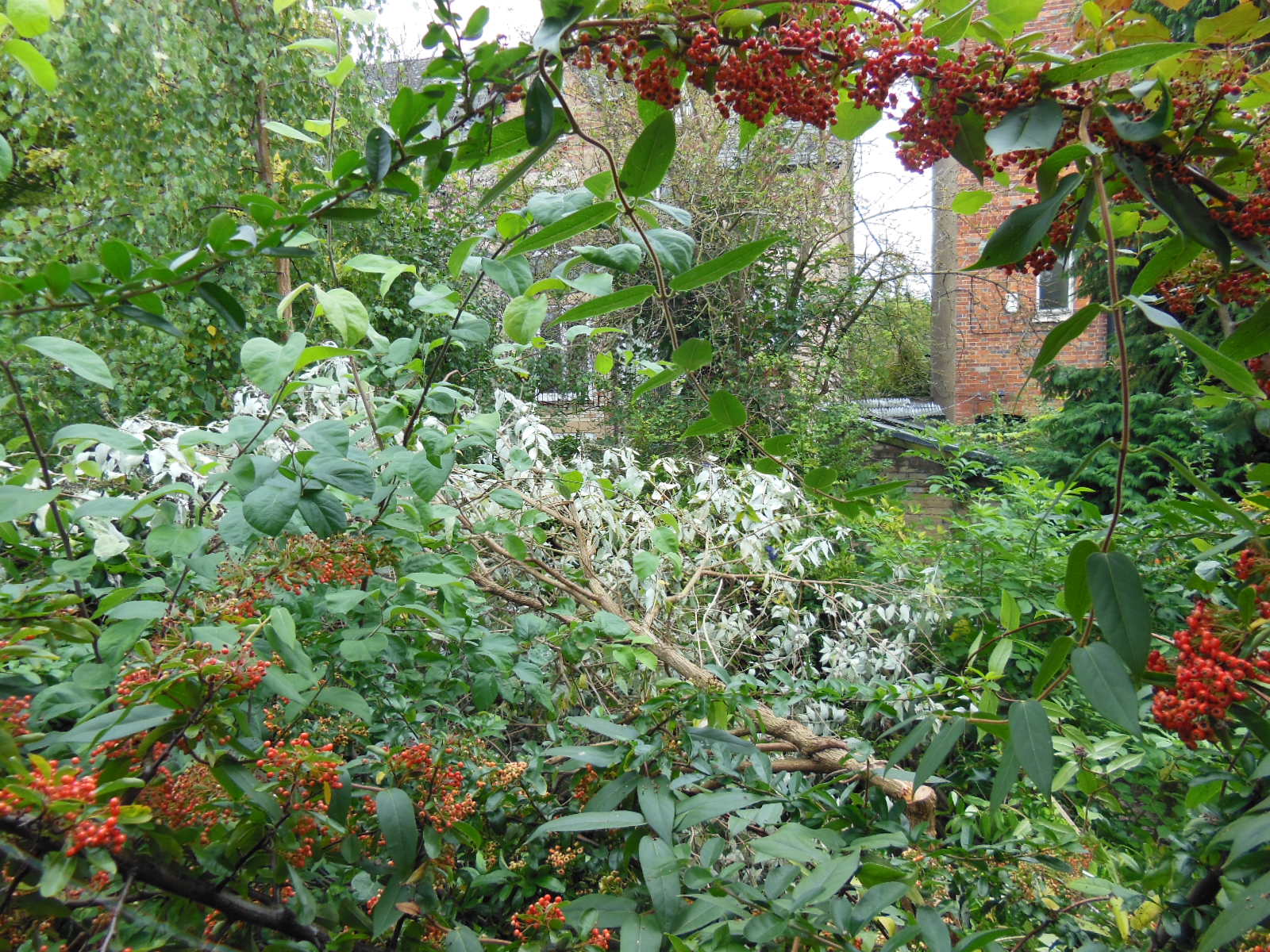
Having de-cluttered the house of furniture, I turned my attention to the garden, and cut it back savagely, much to the disgust of the neighbourhood birds.  After a weekend of hard work I returned to the house for some more de-cluttering.  I had become a fanatic!  One morning I woke up at 5, decided to get up to make a cup of tea, and while my tea was getting cold I sorted through my CD and DVD collection and discarded half of them.

Whereas I used to spend my Saturdays haunting thrift-stores I now wandered through the Little House, casting a jaundiced eye over my possessions, thinking, do I want to dust this for another 50 years?  And I continued to fill large shopping bags with things. 

Last weekend my de-cluttering reached a major peak: first I sorted out the Mouserleum (conservatory), threw out all sorts of ‘this will come in handy some day’ bits & bobs, and made dozens of spiders homeless.  Then I had a quick dinner, and decided to watch a movie.  On route to my Nostalgia Studio, where I watch movies, I passed the bedroom.

The top of the curtains were very dusty, and the bed-hangings impossible to vacuum properly.  Moths had been having orgies in them for years.  I hated to look under the bed, because although I did not store anything there, reaching the dust in its outer reaches was tricky.  Something had to be done.  It was 20:30 hours Saturday night.  I decided to move all the furniture around, the four poster bed, the six foot long wardrobe, the tall linen cupboard.  God gave me strength.  I finished at 23:25 hours, and sank into my bed utterly exhausted.  But the job was done.

Did I mention that my vacuum cleaner is crap?  There are few things as soul destroying as spending two hours hoovering the house, putting the hoover away again, and discovering that the carpet is still covered in dust and fluff.  I had enough!  I bought a Dyson.  Even though I bought a reconditioned one, one third off regular price, it was still expensive.  But I did not care.  I decided to pay for it out of my scarf budget.  I had turned from being a scarf addict to being a Putzteufel (cleaning fiend).

I had recently acquired some humidity meters, and discovered that the humidity in the Little House was unhealthily high, so I bought a dehumidifier.  Every 12 hours I collected 2 litres of water.  This went on for weeks.  Currently the collection rate has slowed to about 1 litre every 12 hours.

Sunday morning, after the Great Bedroom Shift Around, I longed for nothing but rest.  I bought two (!) croissants, the Observer, and barricaded the front door.  Peace at last!  But alas, after a mere half an hour of reading my urge to clean & de-clutter arose again.  Sighing deeply I put the paper aside and set to.  I dusted and vacuum cleaned for about six hours, I wiped the floors and washed the top of wardrobes, I dusted picture frames and polished the stairs.  Clearly I had gone quite mad.

Where will it all end?  Will I wake up on bare boards one day, having de-cluttered my bed?  Will I limit the number of my books to three, like Leberecht Huehnchen – one Bible, one cookbook, and Don Quijote?  My journey has only just begun.


Anyway, I hope all this frantic de-cluttering and cleaning will appease my mucus membranes!